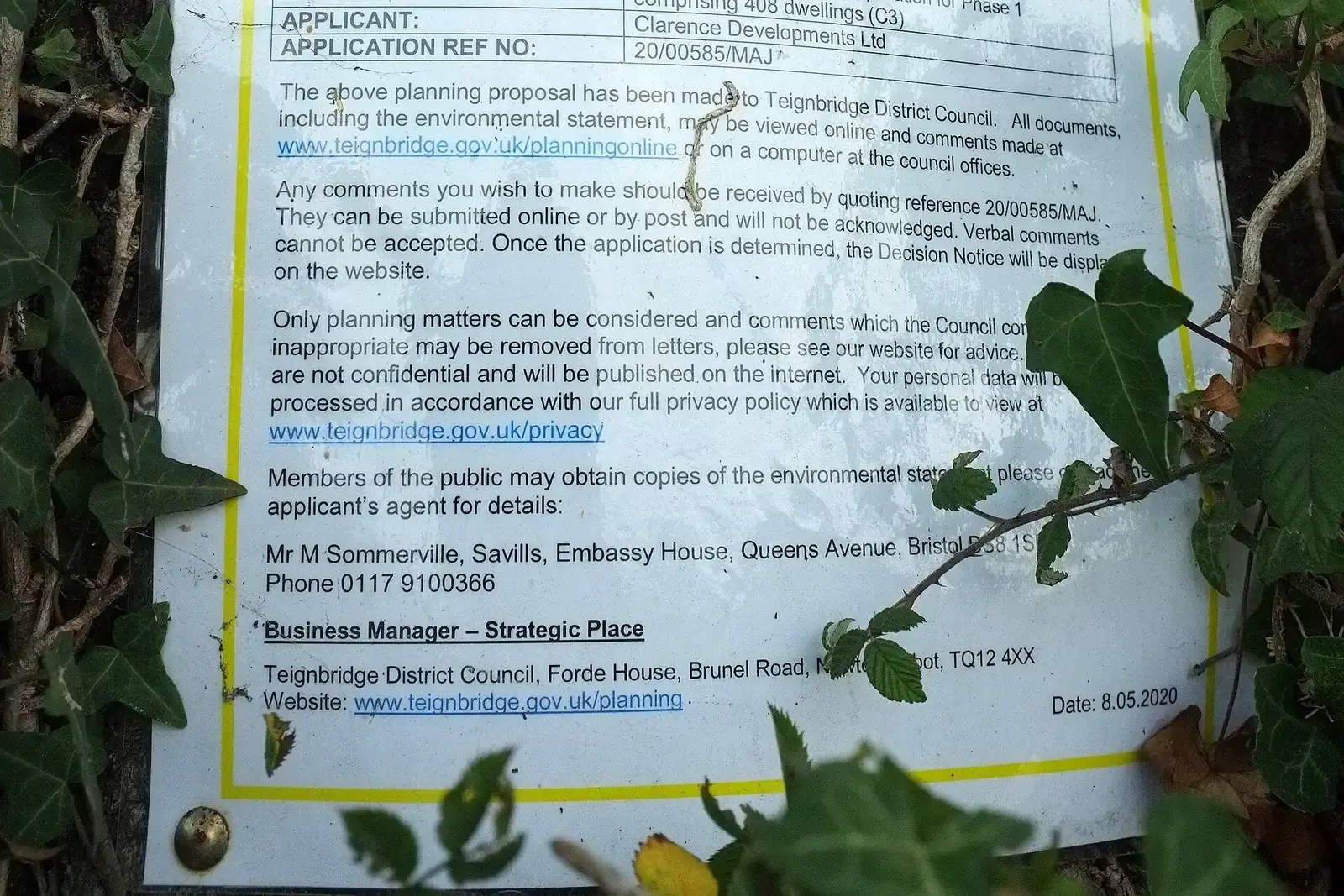
Enforcement notice served in London? Our written review is £355
A notice has a date on which it takes effect, and your appeal must be in before it. We tell you what it requires, when the clock stops and which grounds of appeal fit.
£355 fixed fee, no VAT to add
Prefer WhatsApp? Send us a message · +44 7592 201353
The short answer
An enforcement notice is a formal order from the council to put right a breach of planning control. It names the breach, the steps you must take and the date it takes effect. An appeal must reach the Planning Inspectorate before that date. We read the notice, say which of the appeal grounds fit, and draw the plans for a ground (a) case ourselves. Our fee is £355, no VAT to add.
Enforcement notice review
from £355
- Fixed fee
- £355
- VAT
- None to add
- A plain-English reading of what the notice requires and what it does not
- The date it takes effect and the deadline for your appeal, put at the top of the report
- A view on which of the appeal grounds fit your facts, and which do not
- For ground (a), the planning case: drawings prepared in-house and the policies that support them
- A referral to a planning solicitor for the legal grounds, with a note of what to give them
- A written report you keep and can show a lender, buyer or solicitor
£355. A starting fee: we confirm one fixed figure after checking your address. The council’s own fee, where there is one, is paid to the council.
Get my fixed feeHow an enforcement notice review runs
Send the notice today
Send every page of the notice and its plan, the date you received it and your address. We find the effective date first and tell you the deadline.
We read what it requires
We check what the notice says was built or changed, the steps it demands, the time it gives you to comply, and whether it matches what stands.
Match the grounds
We go through the grounds of appeal in the Act one by one, and say which fit, which are weak, and which belong to a solicitor.
Plans for ground (a)
Where the planning merits are your case, we survey, draw and write it ourselves, so the appeal and the drawings come from one team.
Your report and the next move
You receive a written review with the deadline, the grounds, the risks and a recommended route, and we say who files what.
The deadline is the first thing to find
The Act is clear about timing. Under section 174, an appeal is made by written notice to the Secretary of State before the date specified in the enforcement notice as the date on which it takes effect. Sent by post or electronically, it must be sent so that, in the ordinary course, it is delivered before that date.
The notice must be served at least 28 days before it takes effect, under section 172, so the window is real but short, and part of it has usually gone by the time the notice reaches you. If you miss it, the notice takes effect and you are bound by it. Do not wait for a letter from us before you act on the date: if the notice is about to take effect, contact us and a solicitor the same day.
The grounds of appeal and who handles which
Section 174(2) lists the grounds on which an appeal can be made. Ground (a) is that planning permission ought to be granted. Grounds (b) and (c) argue that the matters did not occur, or are not a breach. Ground (d) is that no enforcement action could be taken in time. Grounds (e) to (g) cover service, steps that go beyond what is necessary, and a compliance period that is too short.
We take ground (a), the planning merits, and we draw the scheme that supports it. Where the case is a point of law, such as that time has run out or that the notice was not served properly, we say so and refer you to a planning solicitor, because we are not solicitors. Often an appeal runs on several grounds at once, and we set out how the two fit together.
- Ground (a): planning permission ought to be granted. This is our work, with drawings.
- Grounds (b) to (e): facts and law about whether there is a breach and whether the notice was served properly. These go to a solicitor.
- Grounds (f) and (g): the steps demanded or the time given. We advise on what is reasonable on site, and a solicitor frames the legal argument.
Where this page stops and enforcement help starts
This review is for a formal notice that has been served and has an appeal deadline. If you only have a letter, an officer’s visit or a planning contravention notice, nothing has been served yet and our planning enforcement help is the right one. They do not overlap.
One thing to know early: a ground (a) appeal is also your one chance to obtain permission after the event, as the guidance puts it, and under section 70C a council may decline to decide a new application that would grant permission for matters in an existing enforcement notice. That is why we choose the route before you file anything.

What our paid review gives that a free one does not
A free review is usually a short opinion before the firm quotes for its own appeal. With a notice already served, you need more: a written report from a chartered architectural technologist (MCIAT) that sets the deadline at the top, goes through every ground and says which you should not rely on.
We read the notice against the planning history and the policies the council relies on, not the notice alone. We weigh every route, including appeal, a redesign to meet the council’s concern, and complying with the notice, rather than the one route we sell. And because we draw the ground (a) scheme in-house, the plans and the planning case are written together.
Planning appeals for householders · All planning problem reports

The notice sets the clock
An enforcement notice states when it takes effect, so the first job is to read that date and the grounds of appeal open to you.
Enforcement notices by the numbers
28 days
The minimum time between service of an enforcement notice and the date it takes effect.
Source: Town and Country Planning Act 1990, section 172 (legislation.gov.uk)
Before
An appeal must be made before the date the notice specifies as the date it takes effect; a posted or electronic appeal must be sent to arrive before then.
Source: Town and Country Planning Act 1990, section 174 (legislation.gov.uk)
7 grounds
Grounds (a) to (g) in section 174(2): from whether permission ought to be granted to whether the compliance period is long enough.
Source: Town and Country Planning Act 1990, section 174 (legislation.gov.uk)
Ground (a)
The ground that planning permission ought to be granted, which is decided on the planning merits and for which drawings matter.
Source: Town and Country Planning Act 1990, section 174 (legislation.gov.uk)
1 chance
The guidance says someone who built without permission has only one opportunity to obtain it after the event, by a retrospective application or a ground (a) appeal.
Source: Planning Practice Guidance: ensuring effective enforcement (GOV.UK)
Section 70C
A council may decline to determine a new application that would grant permission for matters in an enforcement notice issued before it received the application.
Source: Town and Country Planning Act 1990, section 70C (legislation.gov.uk)
No appeal
A breach of condition notice cannot be appealed to the Secretary of State, unlike an enforcement notice; that one is only open to judicial review.
Source: Planning Practice Guidance: ensuring effective enforcement (GOV.UK)
Questions about enforcement notices
How long do I have to appeal an enforcement notice?
Until the date the notice says it takes effect. The appeal has to be made in writing before that date, and posted or electronic appeals must be sent so they would arrive before it. The notice must have been served at least 28 days before that date.
Source: Town and Country Planning Act 1990, section 174 (legislation.gov.uk) · Town and Country Planning Act 1990, section 172 (legislation.gov.uk)
Does an appeal stop the notice?
The guidance says the offence of not complying applies only once the compliance period has gone and there is no outstanding appeal, so a made appeal matters. How the notice behaves while the appeal is decided is a legal point, so confirm it with a planning solicitor.
Source: Planning Practice Guidance: ensuring effective enforcement (GOV.UK)
Can you file the appeal for me?
We prepare the planning case and the drawings for ground (a) and tell you what each ground needs. Legal grounds go to a planning solicitor, and we explain who files which part before the deadline, so nothing falls between us.
What if I miss the deadline?
The notice then takes effect, and ignoring it once the compliance period has run is an offence. Speak to a planning solicitor straight away, as the options are narrow at that point.
Should I submit a retrospective application as well?
Not without taking advice first. The guidance says you only get one opportunity to obtain permission after the event, and a council can decline a new application once a notice exists. We set out which route to use, and in what order, in the review.
Source: Planning Practice Guidance: ensuring effective enforcement (GOV.UK) · Town and Country Planning Act 1990, section 70C (legislation.gov.uk)
Find the deadline before it finds you
Send every page of the notice today. We reply the same working day if you message before 3pm, with the review for £355.