Party wall notices for London homes
Planning Drawings prepares party wall notices for London homes from £42 per adjoining owner, no VAT to add, and reviews drawings and specifications prepared elsewhere from £289. A party wall notice tells the adjoining owner about building work that touches a shared wall, goes up to the boundary or digs near their foundations.
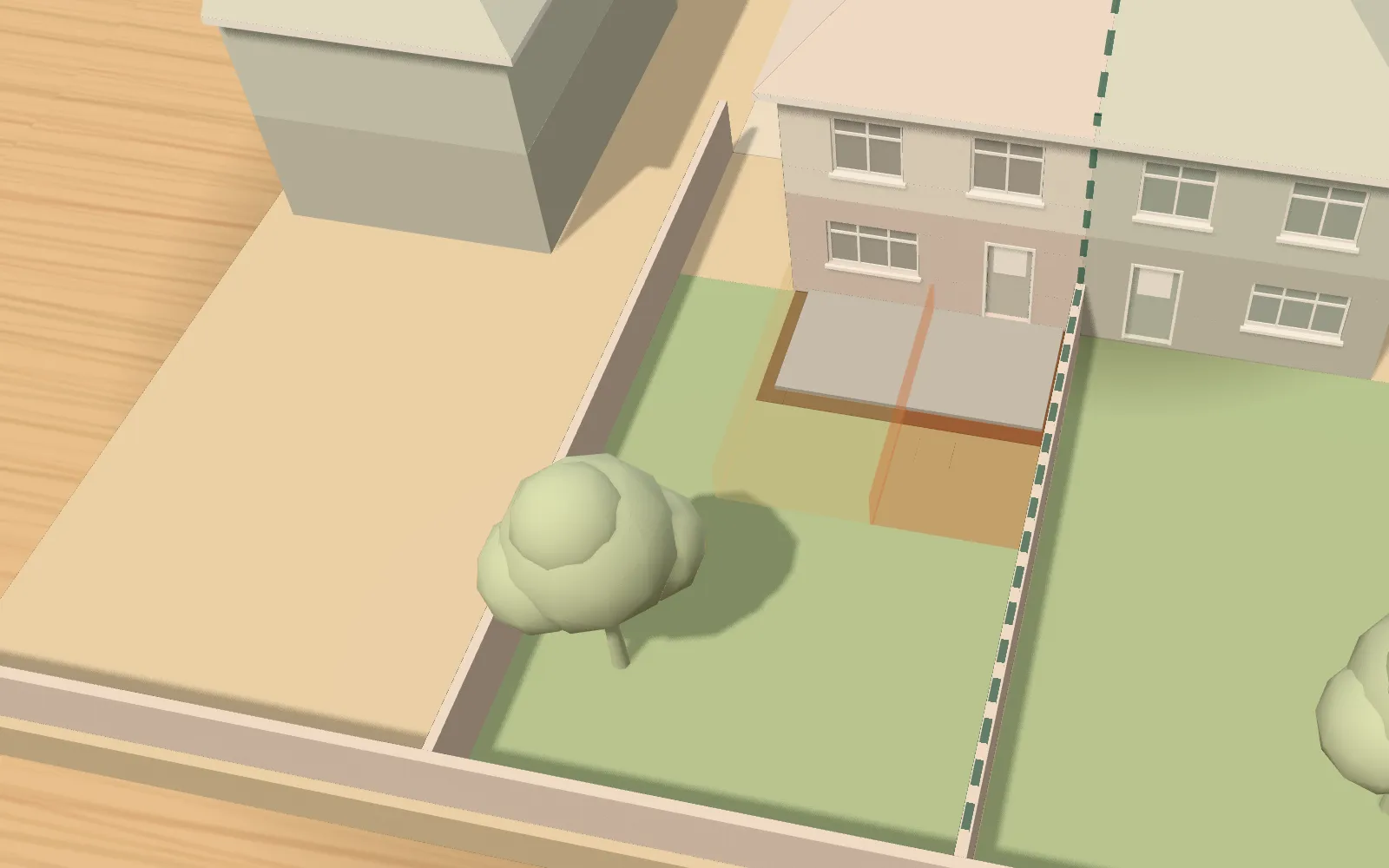
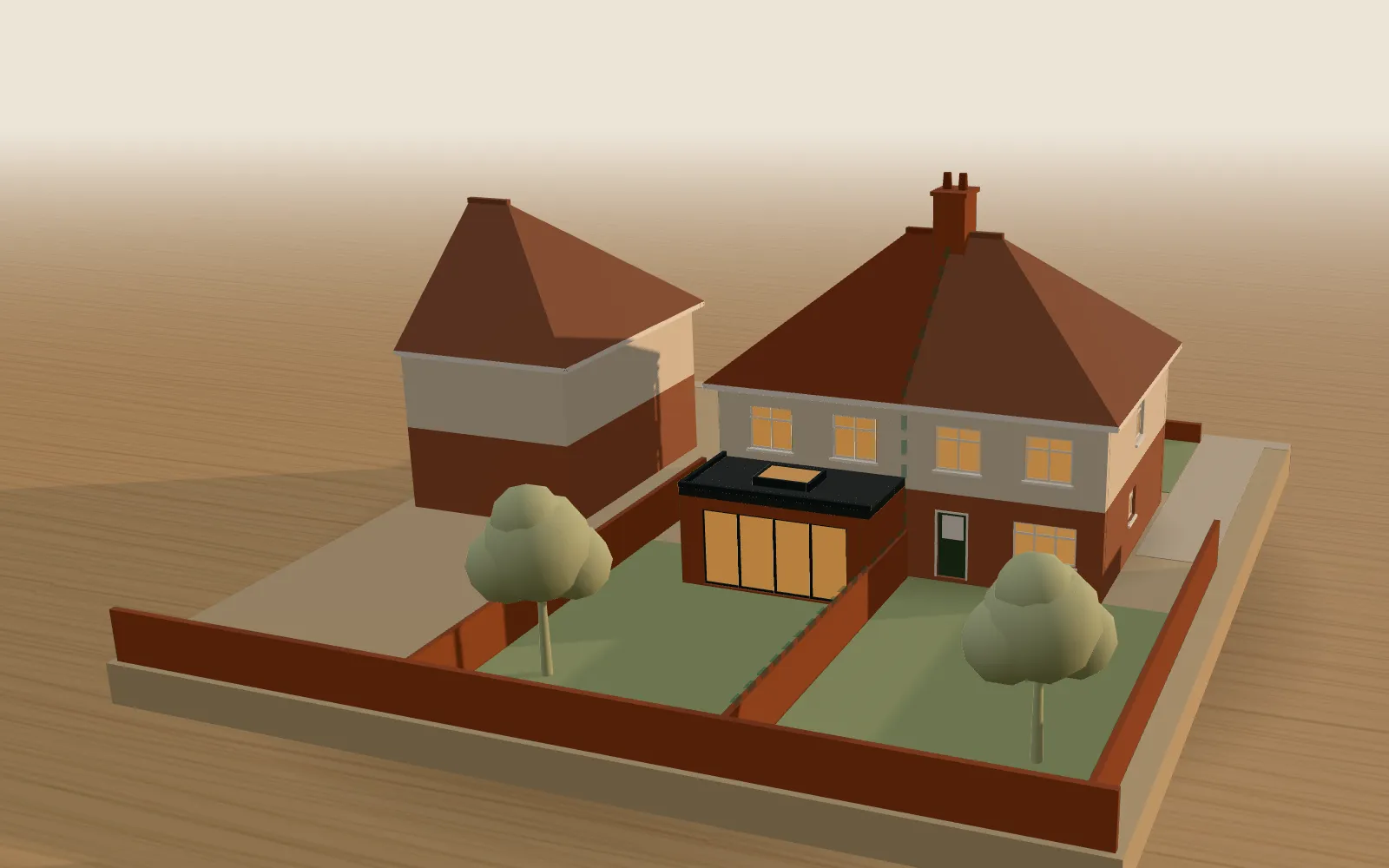
In the model: The shared wall. A dashed line runs up the middle of the pair, marking the wall that the two houses share.
- Notices from £42 per adjoining owner, no VAT to add
- Independent drawing review from £289
- Prepared under the Party Wall etc. Act 1996
Prefer WhatsApp? Send us a message · +44 7592 201353
What is a party wall notice?
A party wall notice is the written notice a building owner serves on the adjoining owner before certain work near a shared wall or boundary, under the Party Wall etc. Act 1996. It describes the work and, where needed, comes with drawings of it. It is separate from planning permission and building regulations approval, so one project can need all three.
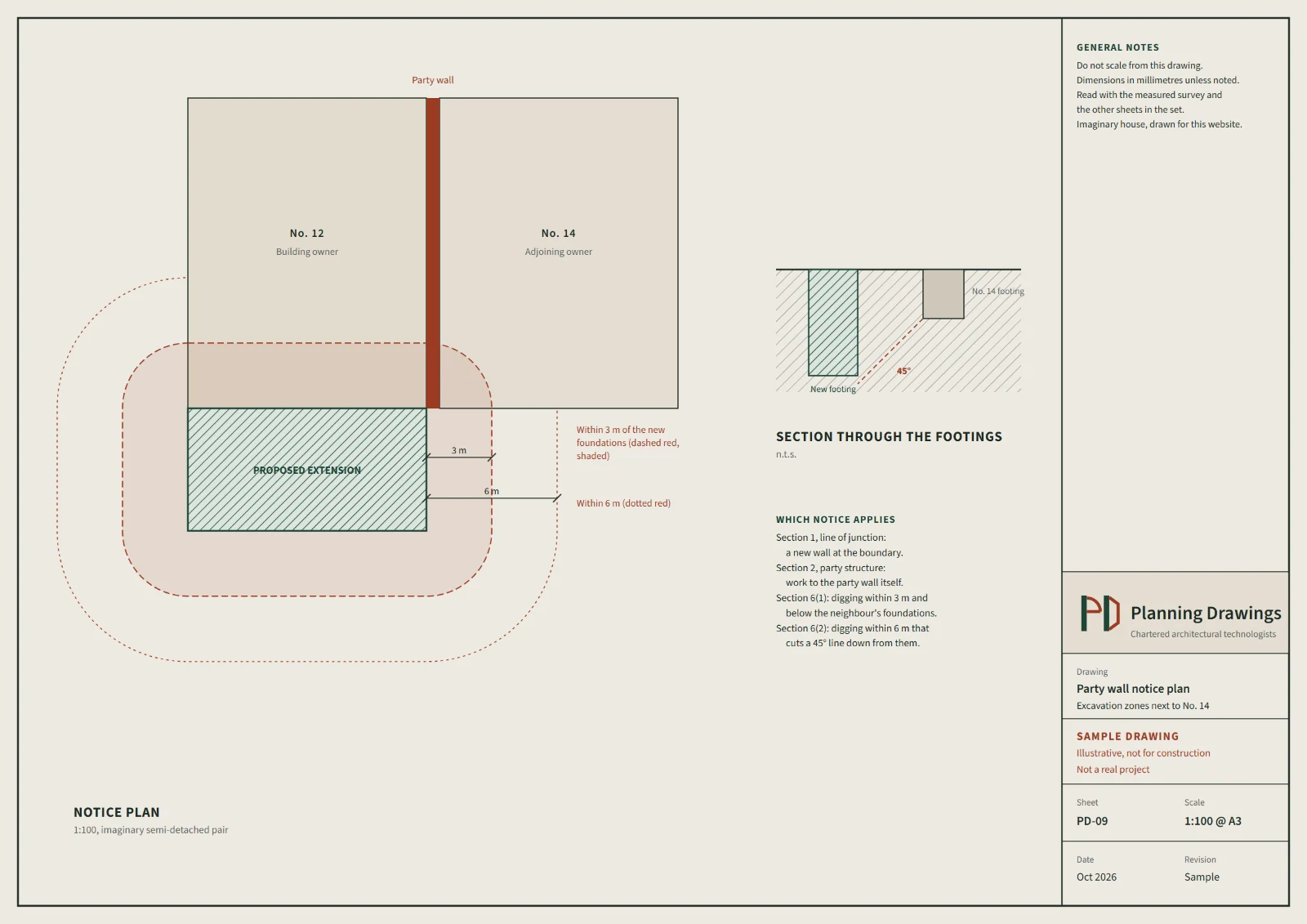
In the model: Three and six metres. Shaded zones on the card ground reach three and six metres out from next door’s walls, the distances section 6 of the Act uses when digging goes near a neighbour’s foundations.
When do you have to serve a party wall notice?
A party wall notice is needed before work that touches a shared wall, goes up to the line between two properties, or digs close to a neighbour’s building. The Act names three situations, listed below with the minimum notice for each. One London project can trigger more than one: a side return built along the boundary can involve both a boundary wall and new foundations.
The notice has to be served before work starts, and the work should not begin until the period has run unless the adjoining owner agrees in writing, so serve early: a dispute adds time.
- New wall on the line of junction between the properties (section 1): at least one month’s notice.
- Work to a wall or structure the two properties share, such as cutting into it or raising it (section 3): at least two months’ notice.
- Excavation close to a neighbouring building, within three or six metres depending on depth (section 6): at least one month’s notice.
How many party wall notices does my project need?
One for each adjoining owner the work affects, so a mid-terrace house can need two if the work touches both sides, which is £84 in notice fees at our rate. The building owner serves each notice, and we prepare the notice and the drawings that explain the work; the fixed fee we send names exactly what it covers.
The adjoining owner can consent in writing or dissent. For work to a shared wall or an excavation, a dispute means surveyors settle the terms of the work in a document called an award.
What do party wall drawings show?
Party wall drawings show the work in relation to the neighbouring property: the shared wall, the new structure and, where it matters, the depth of any excavation. A neighbour can then see what is proposed without having to read a full planning set. We prepare them from your project drawings, so the notice and the design agree.
What is an independent drawing review?
An independent drawing review is a second opinion on drawings and specifications that another firm prepared, carried out by someone who had no part in drawing them. It starts from £289, no VAT to add. Send us the set and tell us what worries you, and we reply with a fixed fee.
In the model: The scaffold. Timber scaffold rises along the shared side, showing where the work will stand against next door’s wall.
From drawings to served notice
Test the work against the Act
We read your drawings against the three situations the Act names: a boundary wall, a shared wall and nearby excavation.
List the adjoining owners
You confirm the name and address of each adjoining owner, and we prepare one notice for each.
Draw the work in context
The drawings show the work against the neighbouring property, taken from your project set.
Serve the notice
You serve it as building owner, with the drawings, and the minimum notice period begins.
Fit the dates into the build
After building control approval, our next-steps pack sets out party wall timing alongside the commencement notice and CIL.
What does a party wall drawing look like?
An illustrative plan of the kind that goes with a notice: the neighbouring house, the shared wall and the proposed work on one sheet.
What do party wall notices and drawing reviews cost?
Party wall notices start at £42 per adjoining owner, and independent drawing and specification reviews at £289, all with no VAT to add. The £42 is the fee for the notice itself, per adjoining owner, so the total depends on how many neighbours the work affects. Fees are confirmed once we have seen the project.
| Drawings or service | From, no VAT to add |
|---|---|
| Party wall notice (per adjoining owner) | £42 |
| Independent drawing and specification review | £289 |
Questions about party wall notices
What happens if my neighbour dissents?
A dissent starts the dispute procedure in section 10 of the Party Wall etc. Act 1996. The two owners either agree on one surveyor or each appoint their own, and the surveyors settle the terms of the work in an award. If the adjoining owner consents in writing instead, no surveyor is needed.
What happens if my neighbour does not reply?
It depends on the notice. For work to a shared wall or an excavation, no reply within 14 days counts as a dispute, not consent, and surveyors settle the terms in an award. A new wall on the line between the properties works differently: if the adjoining owner does not consent in writing within 14 days, it has to be built wholly on your own land, at your own cost.
Which projects can need a party wall notice?
A project can need one if it touches a shared wall, builds on the boundary or digs near a neighbour’s foundations. Examples are a side return built along the boundary, a loft where a steel beam is seated in a shared wall, a basement, and a new wall on the line between properties. A conversion that leaves shared walls and the ground alone may not need one.
Get a fixed fee for your notices
Tell us the postcode, how many neighbours share a wall with you and what the work involves. We reply with a fixed fee, and a message that arrives before 3pm gets a reply that working day.
- Phone
- 020 7131 9705
- +44 7592 201353
- [email protected]
- Office
- 128 City Road, London, United Kingdom, EC1V 2NX
- Replies
- Messages sent before 3pm get a reply the same working day.