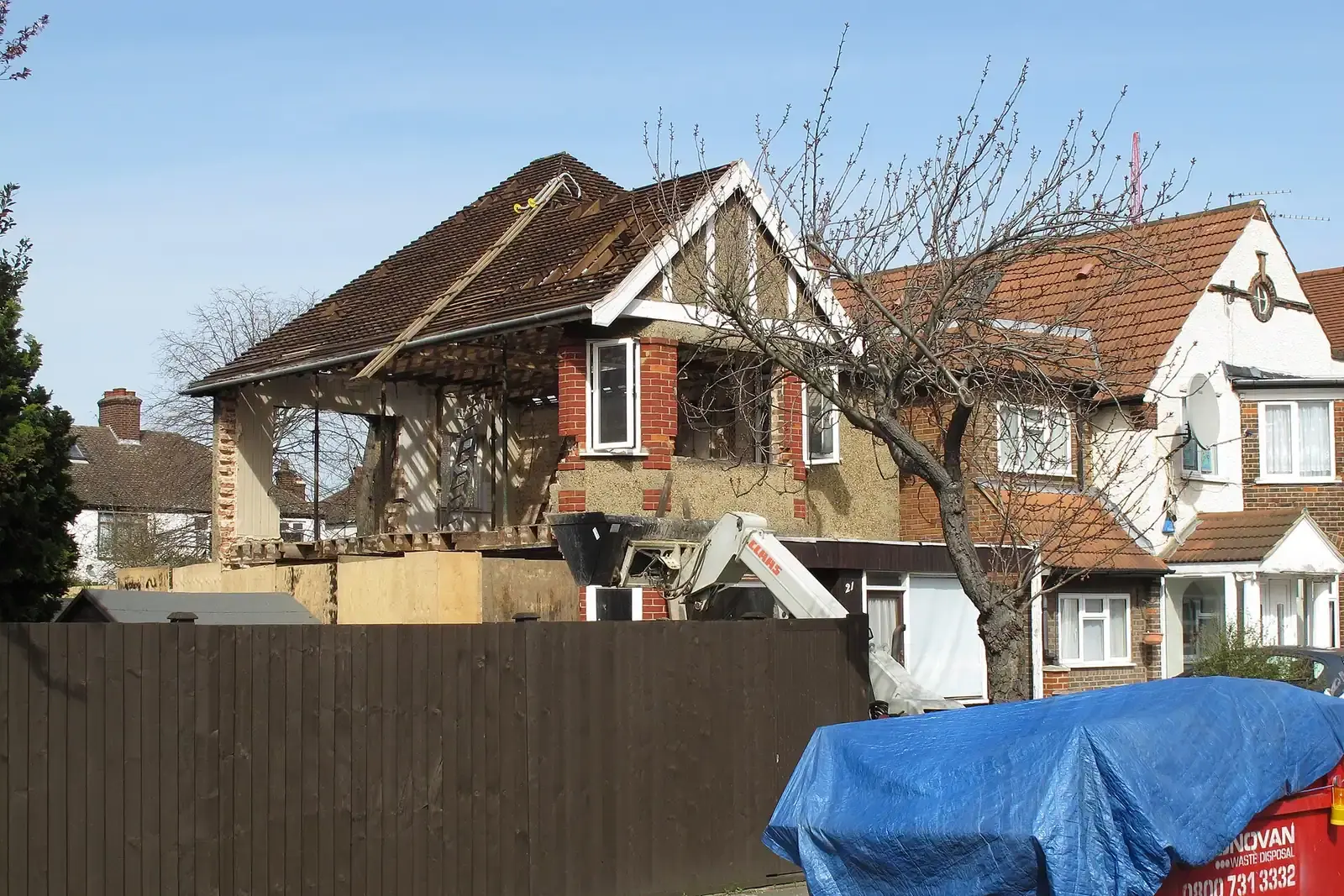
The two fees you pay
The first bill is the council’s. A retrospective application is a planning application like any other, so it pays the planning fee, and for alterations or an extension to a single house that fee is £548 from 1 April 2026. The GOV.UK fee guidance lists retrospective applications among those that pay.
The second bill is for the drawings and the case. Councils ask for the same plans as for any application, drawn to show what is there now, not what was planned. With us that is £475 drawings + £150 survey (£625 total): the measured visit, the as-built drawings, a planning statement and the submission.
Why the drawings cost what they do
Retrospective drawings start with a survey, because nobody can draw an extension as built from the builder’s memory. The surveyor measures the walls, the roof heights and the distance to each boundary, and the neighbour’s windows that the officer will judge the work against.
Then comes the part people underestimate: the case. The statement has to explain why the building, as it stands, meets the council’s policies. Where it does not quite, we say which small change on site would fix it, so the council can grant permission with a condition rather than refuse.
- As-built survey of the work, the house and the boundaries
- Existing and as-built plans, elevations and a section
- Location and block plans with the red line
- Planning statement, forms, ownership certificate and submission
What a refusal really costs
Here the money stops being the main risk. Planning Practice Guidance says a person has only one opportunity to obtain permission after the event, and once an enforcement notice is issued the council can decline to decide a retrospective application under section 70C.
Ignore an enforcement notice and you commit an offence, and the work may have to come down. So the route that costs least is a first application that answers the officer’s questions before they are asked.
Does it cost more because you built first?
No. There is no surcharge in the fee schedule for building first; the council fee for one house is £548 either way. The guidance asks councils to act in proportion to the breach, and many are settled by an application.
What does cost more is drawing work that is already there and may not match any earlier plan. That is why our fee includes the survey, and why it starts at £475 drawings + £150 survey (£625 total) rather than the plain planning drawing fee of £515 drawings + £150 survey (£665 total).
By the numbers
£548
Council fee for a householder application on one house from 1 April 2026.
Source: Planning fees: annual indexation from 1 April 2026 (GOV.UK)
3.8%
The CPI uplift applied to every planning fee on 1 April 2026; fees now rise each April, capped at 10%.
Source: Planning fees: annual indexation from 1 April 2026 (GOV.UK)
10 years
Time a council has to enforce against building work substantially completed on or after 25 April 2024.
Source: Planning Practice Guidance: enforcement and post-permission matters (GOV.UK)
4 years
The limit for building work substantially completed before 25 April 2024.
Source: Planning Practice Guidance: enforcement and post-permission matters (GOV.UK)
1,071
Enforcement notices issued by English district councils in April to June 2026.
Source: Planning applications in England: April to June 2026 (GOV.UK)
93%
Householder applications decided within 8 weeks or an agreed time, year ending June 2026.
Source: Planning applications in England: April to June 2026 (GOV.UK)
s73A
The section of the 1990 Act that lets a council grant permission for development already carried out.
Source: Town and Country Planning Act 1990, section 73A (legislation.gov.uk)
Retrospective planning costs: common questions
Is the council fee higher for a retrospective application?
No. The fee depends on the kind of development, not on whether it is built yet, so one house pays the householder fee.
Source: Planning fees: annual indexation from 1 April 2026 (GOV.UK) · Fees for planning applications (GOV.UK)
Can I get my money back if permission is refused?
The council keeps its fee whatever the decision. Our redraws are free until approval, so if a change on site would win permission, redrawing it costs you nothing more from us.
Is a Lawful Development Certificate cheaper?
If the work was permitted development all along, yes: you prove it is lawful instead of asking permission, and our drawings for that start at £425 drawings + £150 survey (£575 total). We check which route fits before you pay.
Sources
- Town and Country Planning Act 1990, section 73A (legislation.gov.uk)
- Planning Practice Guidance: enforcement and post-permission matters (GOV.UK)
- Planning fees: annual indexation from 1 April 2026 (GOV.UK)
- Fees for planning applications (GOV.UK)
- Planning applications in England: April to June 2026 (GOV.UK)
About the author. Ben Shaukat is Managing Director of Property Architecture Ltd, which trades as Planning Drawings.
Published by Planning Drawings. Checked against the sources above on . Planning rules change; check your council before you build.